
S&P Global US PMIs expected to ease slightly in August, still showing solid growth
- The US S&P Global flash PMIs for August are expected to show that economic activity kept growing at healthy levels.
- Services and manufacturing PMIs are seen ticking down but highlighting comparatively strong economic activity.
- The US Dollar is likely to remain on the back foot, weighed by the US Treasury’s plans to boost long-term Government Bonds.
S&P Global will release the preliminary figures of August’s United States Purchasing Managers' Indices (PMIs), a report collecting top private sector executives' opinions about business conditions, to provide an early indication of momentum in the world’s largest economy.
The report includes three measures: the Manufacturing PMI, the Services PMI, and the Composite PMI (a weighted combination of the two), and covers a wide range of aspects, from production or export activity to capacity utilisation, employment, and inventory levels.
PMI numbers indicate sector expansion when above 50 and contraction otherwise.
July’s figures highlighted a sharp improvement in business activity, as the S&P Global Composite PMI jumped to 54.5 from June’s 51.9, beating market expectations and recording its best performance since October 2025. Nevertheless, Chris Williamson, Chief Business Economist at S&P Global Market Intelligence, warned that manufacturing activity slowed down, weighed down by supplier delays due to the Middle East conflict.
What can we expect from the August S&P Global PMI report?
For August, the market consensus anticipates a mild slowdown in economic activity, with the Manufacturing PMI ticking down to 53.8 from July’s 53.9 reading and the Services PMI easing to 54.0 from last month’s 54.6.
Barring a significant miss, August figures will still highlight healthy growth in both the manufacturing and services sectors, especially if compared with most developed economies. In general terms, PMI data from July and August is likely to remain consistent with steady GDP growth and endorse the view of US economic exceptionalism amid a struggling global economy.
July’s report warned that some of the improvements seen in the last month would prove short-lived, as the gain in hospitality spend was mostly due to special, one-off events such as the World Cup while upside price pressures threaten to weaken demand and constrain growth.
In that sense, a sharper-than-expected slowdown is likely to increase investors’ concerns about the economic outlook, triggered by the disappointing US Nonfarm Payrolls report seen earlier in the month. This would add bearish pressure to an already weak US Dollar, which has been hammered this week by the US Treasury’s plan to increase its purchases of long-term Government debt to stem the bond crisis.
A positive surprise, on the contrary, is likely to improve confidence in the US economy, although the impact on the US Dollar will likely remain limited, unless there is a sharp deviation from market expectations.
When will the August flash US S&P Global PMIs be released, and how could they affect EUR/USD?
The S&P Global Manufacturing, Services, and Composite PMIs report will be released at 13:45 GMT and is expected to show a moderate slowdown in US business activity.
Earlier on the day, the Eurozone’s HCOB Flash PMIs beat expectations, as manufacturing activity expanded at a faster pace than anticipated and Services PMI kept growing at a steady pace, although at levels consistent with slow growth. The data had a moderately positive impact on the EUR/USD.
EUR/USD Daily Chart
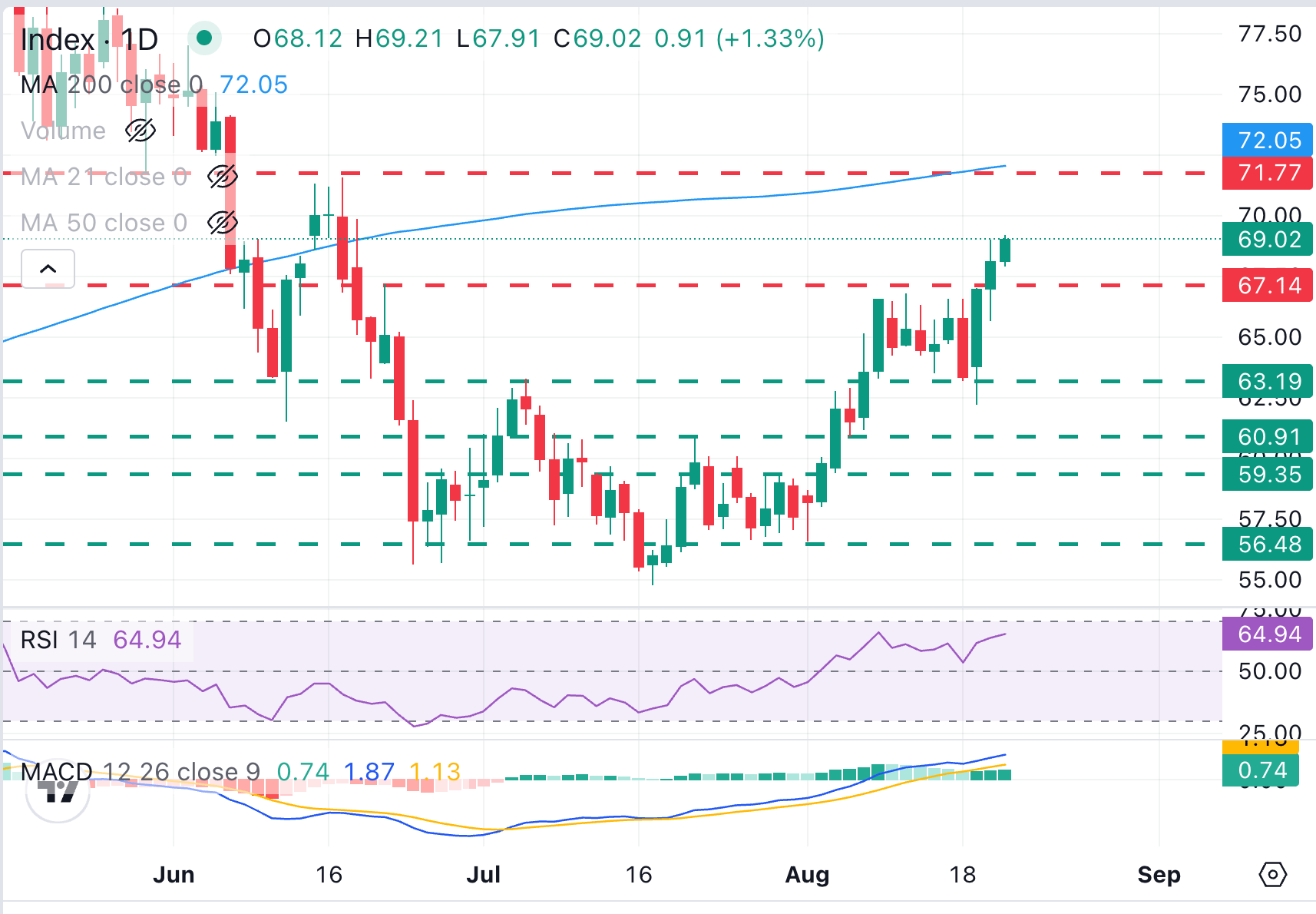
Guillermo Alcalá, FX analyst at FXStreet, observes the EUR/USD technical picture showing a solid bullish momentum after breaching the top of the last two months' trading range, and the key 200-day Simple Moving Average (SMA), at 1.1630, a very popular indicator for FX traders. The Relative Strength Index (RSI), however, highlights heavily overbought levels in most timeframes, which should act as a warning for buyers.
A confirmation above the late May highs at 1.1685 would clear the path towards the 1.1800 resistance area, which capped bulls several times in early May. Failure to breach 1.1685, on the other hand, would bring the mentioned 200-day SMA back into focus.
US Dollar FAQs
The US Dollar (USD) is the official currency of the United States of America, and the ‘de facto’ currency of a significant number of other countries where it is found in circulation alongside local notes. It is the most heavily traded currency in the world, accounting for over 88% of all global foreign exchange turnover, or an average of $6.6 trillion in transactions per day, according to data from 2022. Following the second world war, the USD took over from the British Pound as the world’s reserve currency. For most of its history, the US Dollar was backed by Gold, until the Bretton Woods Agreement in 1971 when the Gold Standard went away.
The most important single factor impacting on the value of the US Dollar is monetary policy, which is shaped by the Federal Reserve (Fed). The Fed has two mandates: to achieve price stability (control inflation) and foster full employment. Its primary tool to achieve these two goals is by adjusting interest rates. When prices are rising too quickly and inflation is above the Fed’s 2% target, the Fed will raise rates, which helps the USD value. When inflation falls below 2% or the Unemployment Rate is too high, the Fed may lower interest rates, which weighs on the Greenback.
In extreme situations, the Federal Reserve can also print more Dollars and enact quantitative easing (QE). QE is the process by which the Fed substantially increases the flow of credit in a stuck financial system. It is a non-standard policy measure used when credit has dried up because banks will not lend to each other (out of the fear of counterparty default). It is a last resort when simply lowering interest rates is unlikely to achieve the necessary result. It was the Fed’s weapon of choice to combat the credit crunch that occurred during the Great Financial Crisis in 2008. It involves the Fed printing more Dollars and using them to buy US government bonds predominantly from financial institutions. QE usually leads to a weaker US Dollar.
Quantitative tightening (QT) is the reverse process whereby the Federal Reserve stops buying bonds from financial institutions and does not reinvest the principal from the bonds it holds maturing in new purchases. It is usually positive for the US Dollar.
Fed FAQs
Monetary policy in the US is shaped by the Federal Reserve (Fed). The Fed has two mandates: to achieve price stability and foster full employment. Its primary tool to achieve these goals is by adjusting interest rates. When prices are rising too quickly and inflation is above the Fed’s 2% target, it raises interest rates, increasing borrowing costs throughout the economy. This results in a stronger US Dollar (USD) as it makes the US a more attractive place for international investors to park their money. When inflation falls below 2% or the Unemployment Rate is too high, the Fed may lower interest rates to encourage borrowing, which weighs on the Greenback.
The Federal Reserve (Fed) holds eight policy meetings a year, where the Federal Open Market Committee (FOMC) assesses economic conditions and makes monetary policy decisions. The FOMC is attended by twelve Fed officials – the seven members of the Board of Governors, the president of the Federal Reserve Bank of New York, and four of the remaining eleven regional Reserve Bank presidents, who serve one-year terms on a rotating basis.
In extreme situations, the Federal Reserve may resort to a policy named Quantitative Easing (QE). QE is the process by which the Fed substantially increases the flow of credit in a stuck financial system. It is a non-standard policy measure used during crises or when inflation is extremely low. It was the Fed’s weapon of choice during the Great Financial Crisis in 2008. It involves the Fed printing more Dollars and using them to buy high grade bonds from financial institutions. QE usually weakens the US Dollar.
Quantitative tightening (QT) is the reverse process of QE, whereby the Federal Reserve stops buying bonds from financial institutions and does not reinvest the principal from the bonds it holds maturing, to purchase new bonds. It is usually positive for the value of the US Dollar.